
Singapore's Corruption Control Framework
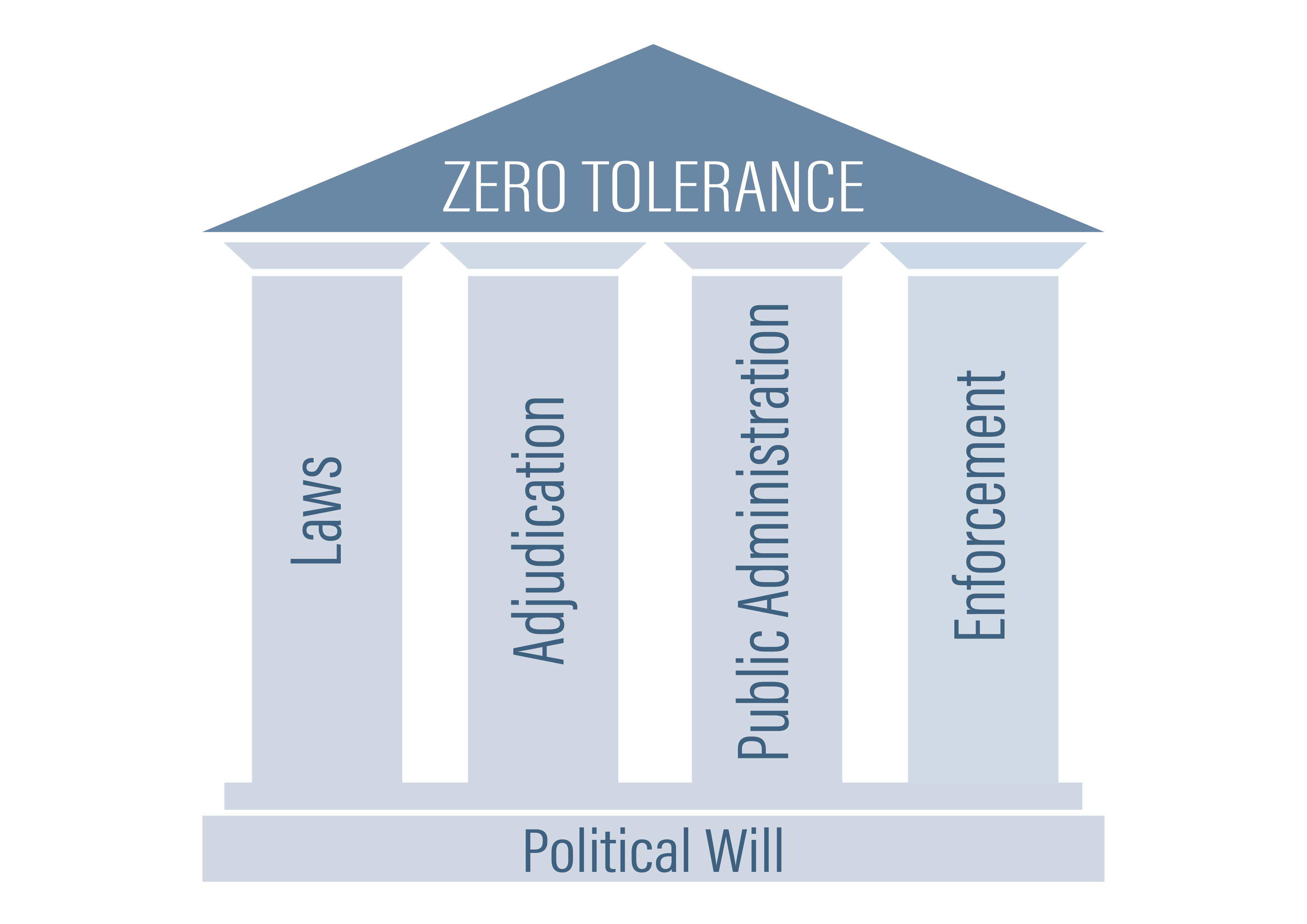
Singapore's success in fighting corruption is the result of a corruption control framework with four key pillars: laws, adjudication, enforcement, and public administration; underpinned by political will and leadership. Learn how the country's zero-tolerance approach keeps corruption in check.
Last updated on 9 July 2026
Overview
Today, Singapore enjoys a well-earned reputation for a high level of incorruptibility. The success of Singapore in fighting corruption is the result of an effective corruption control framework with its four key pillars of laws, adjudication, enforcement and public administration, underpinned by political will and leadership. Singapore takes a whole-of-government approach to combatting corruption.
Political Will
The political will to eradicate corruption was established by Singapore’s founding Prime Minister, Mr Lee Kuan Yew, when the People’s Action Party (PAP) was elected into government in 1959. The PAP was determined to build an incorruptible and meritocratic government, and took decisive and comprehensive action to stamp out corruption from all levels of Singapore’s society. As a result of the government’s unwavering political commitment and leadership, a culture of zero tolerance against corruption has become ingrained into the Singapore psyche and way of life.
Laws
Singapore relies on two key legislations to fight corruption; the Prevention of Corruption Act (PCA), and the Corruption, Drug Trafficking and Other Serious Crimes (Confiscation of Benefits) Act (CDSA). The PCA has a wide scope which applies to persons who give or receive bribes in both the public and private sector. The CDSA, when invoked, confiscates ill-gotten gains from corrupt offenders. Together, the two laws ensure that corruption remains a high-risk low-rewards activity. Upon the conclusion of investigations by the CPIB, all alleged corruption cases will be handed over to the Attorney-General’s Chambers (AGC), the prosecutorial arm of the Singapore Criminal Justice System, to obtain the Public Prosecutor’s consent to proceed with Court proceedings.
Adjudication
In Singapore, an independent judiciary provides insulation from political interference. The Chief Justice is appointed by the President on advice from the Prime Minister and the Council of Presidential Advisers. District judges and magistrates are appointed by the President with advice from the Chief Justice. The judiciary’s independence is guaranteed in the Constitution (Article 98). Transparent and objective in its administration of the rule of law, the judiciary recognises the seriousness of corruption and adopts a stance of deterrence by meting out stiff fines and imprisonment towards corrupt offenders.
Public Administration
The Singapore Public Service is guided by a Code of Conduct, which sets out the high standards of behaviour expected of public officers based on principles of integrity, incorruptibility and transparency. The practice of meritocracy in the Public Service, together with regular reviews of administrative rules and processes to improve efficiency also reduce the opportunities for corruption. In the course of investigations involving government agencies, CPIB will also conduct procedural reviews to point out work areas or procedures that can be exploited for corrupt practices. Some examples of how effective public administration is carried out to prevent corruption are listed below.
Conduct of Public Officers
Singapore has various instruments setting out the behaviour expected of those in the Singapore Public Service, including the Public Sector (Governance) Act, government instruction manuals on conduct and discipline, the Civil Service Code of Conduct, regulations and directions.
The government instruction manuals on conduct and discipline mandate public servants to declare all real or perceived conflicts of interest, interests in investments and properties (including those of their spouses and financially dependent children) and gifts offered on account of their official position or work. Failure to do so may result in disciplinary proceedings, which may result in penalties or even dismissal.
Government Procurement
Singapore has a decentralised system for government procurement activities governed by the Government Procurement Act and subsidiary legislation. Government procurement entities are required to adhere to the Government Instruction Manual on Procurement, which contains central guidelines issued by the Ministry of Finance.
All public procurement is required to be conducted through the country’s one-stop e-procurement portal, Government Electronic Business (GeBIZ). A supplier directory is also made available to the public.
Election Matters
Political donations and associated requirements for political parties and candidates are regulated under the Political Donations Act and election legislation (i.e. the Parliamentary Elections Act and the Presidential Elections Act). Donors are required to submit a donation report and a declaration form to the Registrar of Political Donations if they make multiple donations with an aggregate value of 10,000 Singaporean dollars or more to a political association in a given calendar year (sect. 21 of the Political Donations Act).
Enforcement
The Corrupt Practices Investigation Bureau (CPIB) is the sole agency responsible for combating corruption in Singapore. The CPIB is under the Prime Minister’s Office (PMO) and reports directly to the Prime Minister, enabling the CPIB to operate independently. The functional independence of the CPIB is guaranteed under the Constitution (Article 22G). Through more than 60 years of corruption-fighting, a deterrent stance has always been adopted, ensuring that there are no cover-ups and corruption is fought without fear or favour. With a fearsome and trusted reputation, the CPIB acts swiftly and vigorously to enforce the tough anti-corruption laws impartially for both public and private sector corruption. During the investigation process, the CPIB will work with various government agencies and private organisations to gather evidence and obtain information.